

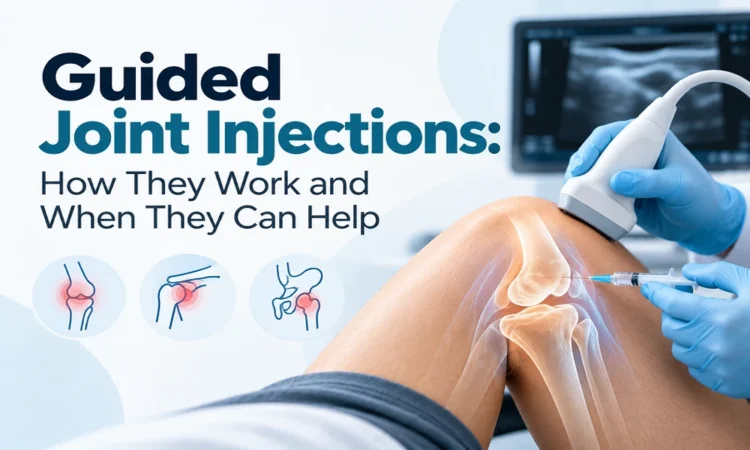
Joint and tendon pain has a way of taking over daily life. Walking the dog, lifting a kettle or sleeping on one side can all become a struggle. When rest, painkillers and exercises are not enough, an injection into or around the painful area is sometimes suggested. Understanding what these injections do, what they do not do, and why the way they are delivered matters can help you make a confident decision.
What is a guided injection?
A guided injection is one where the clinician uses live ultrasound imaging to see the needle as it moves towards the target. Rather than relying on anatomical landmarks alone, they can watch the tip reach the exact tendon sheath, bursa or joint space and see the medication spread. Research on shoulder and other joints has generally found that image guidance improves placement accuracy, which matters because a small structure is easy to miss.
The main types of injection
Different injections work in different ways, and the right one depends on your diagnosis.
• Corticosteroid (cortisone) injections: a strong anti-inflammatory medicine that can reduce pain and swelling, often providing relief for weeks to a few months. They are commonly used for shoulder, hip and knee conditions, tendon sheath problems and bursitis.
• Hyaluronic acid: a gel-like substance that mimics the natural lubricant in joints. It is most often used for knee osteoarthritis, with the aim of improving comfort and movement. Evidence on how much it helps varies between studies and between patients.
• Platelet-rich plasma (PRP): a preparation made from a small sample of your own blood, concentrated and injected into an injured tendon or joint. It is used for some tendon problems, though research findings are mixed and it should be discussed as an option rather than a guarantee.
• Polyacrylamide hydrogel (such as Arthrosamid): a longer-acting gel injected into the knee for osteoarthritis. It is a newer option, and a specialist can explain whether you are a suitable candidate.
• Local anaesthetic or nerve blocks: used to numb a specific nerve or area, sometimes as a way of confirming where pain is coming from.
Conditions that are often treated
Guided injections are commonly considered for:
• Shoulder problems, including frozen shoulder, subacromial pain, calcific tendinitis and AC joint pain
• Tennis elbow and golfer’s elbow
• Trigger finger and ganglion cysts in the hand and wrist
• Hip pain, including trochanteric bursitis on the outer side of the hip
• Knee osteoarthritis
• Plantar fasciitis and Achilles tendon problems in the foot and ankle
• Morton’s neuroma, a painful nerve thickening between the toes
An injection is rarely the whole answer. Where a problem stems from overload, weak muscles or poor movement patterns, an injection can reduce pain enough to let you engage properly with physiotherapy, which is what tends to protect against the problem returning.
What to expect on the day
Your appointment usually starts with a discussion of your symptoms and, often, a scan of the area to confirm the diagnosis. If an injection is appropriate, the skin is cleaned, sometimes numbed, and the needle is guided to the target under ultrasound. The injection itself typically takes just a few minutes.
Afterwards you may be advised to rest the area for a day or two. Some people notice a temporary flare of soreness within the first couple of days, particularly after steroid injections, before the benefit builds. You can normally go home straight away, though you may be advised not to drive if a limb has been numbed.
Risks and limitations
Like any treatment, injections carry risks. These include temporary pain, bruising, infection (which is rare but serious), skin thinning or lightening at the injection site, and short-term rises in blood sugar in people with diabetes. Repeated steroid injections into or around a tendon can weaken it, which is why they are generally limited in number and spaced apart. It is important to tell your clinician about any medicines you take, especially blood thinners, and about allergies and any current infection.
Relief is also not guaranteed or permanent. Steroids tend to work best as a short to medium-term measure, and other options need a clear discussion about realistic expectations. Surgery may still be the best long-term answer for some conditions.
Questions to ask before you go ahead
• What is my diagnosis, and how was it confirmed?
• Why is this injection suitable for me compared with physiotherapy, medication or surgery?
• Will the injection be ultrasound-guided?
• What benefits and risks should I realistically expect?
• How many injections are safe, and how long should I wait between them?
• What happens if it does not help?
Finding the right care in South Wales
If you are looking for care in Cardiff, Cowbridge, Penarth or the wider Vale of Glamorgan, choose a service where the doctor makes the diagnosis, explains the alternatives and performs the treatment. A clinic offering ultrasound-guided injection therapy should be able to explain why a particular medicine has been chosen for your condition. If your symptoms suggest a problem that may need a surgical opinion, a dedicated orthopaedic clinic can assess whether an injection is the right first step or whether other treatment should be considered.
The bottom line
Guided injections can be a useful part of managing joint and tendon pain, particularly when they reduce symptoms enough for you to rebuild strength and movement. They work best when the diagnosis is clear, the treatment is matched to it, and expectations are realistic. Ask questions, and do not be afraid to take time before deciding.
This article is for general information only and is not a substitute for personal medical advice. Speak to a qualified healthcare professional about your own symptoms and treatment options.