
HEALTHCARE ADVERTISING GUIDE
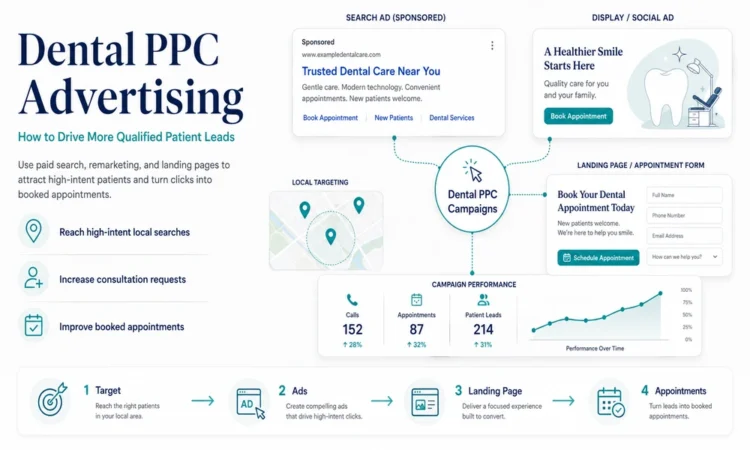
Dental PPC advertising can generate calls and appointment requests quickly, but lead volume alone does not make a campaign successful. The practice needs the right procedure mix, local targeting, landing pages, phone process, and conversion tracking to turn paid traffic into scheduled patients.
A strong dental and medical PPC strategy separates services with different economics and measures performance beyond the initial form submission. The goal is to understand which campaigns produce qualified patients, booked appointments, and accepted treatment.
This guide explains how dental practices can structure paid search campaigns to attract better leads, reduce wasted spend, and make budget decisions using patient outcomes instead of clicks.
What This Post Covers
- Choosing procedures based on patient value and capacity
- Separating branded, emergency, general, and specialty campaigns
- Targeting high-intent dental keywords
- Building negative keyword lists for irrelevant searches
- Improving local targeting and ad messaging
- Creating procedure-specific landing pages
- Tracking calls through booked and completed appointments
1. Choose the Procedures the Practice Wants to Grow
A dental practice should not begin by advertising every service. Start with the procedures that have available chair time, healthy patient value, and a clear treatment path.
Emergency dentistry, general new-patient exams, implants, clear aligners, cosmetic services, and dentures all behave differently in paid search. They have different click costs, urgency, consultation requirements, case values, and close rates.
Question to Answer: Which procedures have both available capacity and strong patient value?
2. Separate Campaigns by Intent and Economics
A single campaign containing every dental keyword gives the practice little control over where the budget goes. Generic and branded clicks may consume the money before high-value procedures receive enough traffic.
Most practices benefit from separating branded searches, emergency care, general dentistry, implants, and cosmetic or orthodontic services when conversion volume and budget allow. Each campaign can then use its own budget, ads, landing page, and performance target.
Question to Answer: Do services with very different patient values currently share one budget?
3. Target Keywords That Indicate Patient Action
The strongest dental keywords usually indicate that the searcher wants a provider, appointment, price estimate, or specific procedure. Examples include local dentist searches, emergency terms, procedure names, and consultation-related phrases.
Group keywords by intent. Someone searching for an emergency dentist wants immediate availability and a phone number. Someone comparing implant costs wants financing information, proof, and a consultation. Someone researching what a root canal is may not be ready to choose a practice.
Begin with phrase and exact match when the account has limited data. Broader matching can be tested later after the practice has reliable conversion tracking and a strong history of negative keywords.
Question to Answer: Which keywords represent patients ready to contact a practice rather than general research?
4. Build Negative Keywords Before the First Click
Dental search traffic includes employment queries, education, free-care searches, insurance plans, home remedies, products, and academic research. These terms can create expensive waste when they are not excluded.
Create negatives for jobs, careers, salaries, dental schools, continuing education, free services, unsupported insurance plans, home treatment, product shopping, and informational phrases that do not match the campaign goal.
Question to Answer: Which irrelevant searches have consumed budget during the last 30 days?
5. Control Local Targeting Carefully
Dental patients usually choose a practice within a practical travel area, but the appropriate radius depends on the procedure. Patients may travel farther for implants or specialty treatment than for routine cleanings.
Use presence-based geographic settings and review the locations where clicks actually occurred. Exclude areas that consistently produce weak leads or are difficult for the practice to serve.
Question to Answer: Are ads reaching people who can realistically visit the location offering the service?
6. Write Ads That Match the Patient’s Decision
Dental ads should communicate the information most relevant to the search. Emergency patients care about availability and speed. Implant and cosmetic patients care about experience, financing, consultations, and proof. General dentistry patients may care about insurance, family scheduling, and new-patient availability.
Use specific, supportable details such as same-day appointments, evening hours, financing options, technology, languages spoken, or the providers available at the location. Avoid generic claims that every competitor can make.
Question to Answer: Does each ad reflect the urgency and concerns of that specific procedure?
7. Use Procedure-Specific Landing Pages
A visitor who clicked an implant ad should arrive on an implant page, not the homepage. Message alignment reduces confusion and makes it easier for the patient to decide whether to call or request a consultation.
Include a mobile click-to-call number, short appointment form, dentist information, location details, accepted insurance, financing guidance, reviews, and relevant before-and-after examples when appropriate. Explain what happens after the inquiry.
Question to Answer: Can a mobile patient understand the service and request an appointment quickly?
8. Treat Phone Handling as Part of PPC Performance
Many dental leads call instead of submitting a form. If the phone is not answered, the caller may contact the next practice in the search results. Advertising performance therefore depends partly on front-desk availability and follow-up speed.
Track missed calls, answer rate, call duration, booked appointments, and reasons leads did not schedule. Use call recordings only when legally permitted and handled according to the practice’s privacy and compliance requirements.
Provide the team with a consistent intake process for each campaign. An implant inquiry may require different questions and scheduling options than an emergency call or a new-patient cleaning request.
Question to Answer: What percentage of paid-search calls become scheduled appointments?
9. Track Leads Through the Patient Funnel
Google Ads should record calls, forms, and online scheduling, but the practice should continue tracking what happened after the lead arrived. A conversion is more valuable when it becomes a booked, completed, and revenue-producing appointment.
Keep patient health information and clinical details inside approved practice systems. Advertising platforms need the conversion outcome, not sensitive treatment information in URLs, event names, or form data.
When operationally and legally appropriate, use offline conversion processes to distinguish qualified leads, scheduled appointments, and completed visits. This gives bidding systems a better signal than treating every submission as equal.
Question to Answer: Can the practice connect advertising spend to booked and completed patients by procedure?
10. Allocate Budget by Cost per Booked Patient
Budget should follow profitable patient demand, not an equal split between campaigns. A procedure with higher click costs may deserve more funding when the resulting patients have greater value and strong case acceptance.
Review spend, qualified leads, booked appointments, completed visits, cost per booked patient, and estimated patient value by campaign. Separate branded performance so inexpensive name searches do not make non-branded acquisition appear stronger than it is.
Question to Answer: Which campaign produces the best combination of patient quality, appointment volume, and value?
In Summary
Dental PPC advertising drives better leads when campaigns reflect the way patients search and the way the practice earns revenue. Separate services with different intent and economics, target action-oriented keywords, remove irrelevant traffic, and give each procedure a focused landing page.
The advertising account is only one part of the system. Phone response, scheduling, consultation follow-up, treatment acceptance, and accurate tracking all determine whether paid traffic becomes profitable growth.
Judge performance by cost per booked and completed patient whenever possible. Once the practice can see that number by procedure, budget decisions become much clearer.